Bonus Breakdown: The Real Math on Free Bets, No-Deposit Offers, and Poker Chips
24 Mar 2026
Bonus Breakdown: The Real Math on Free Bets, No-Deposit Offers, and Poker Chips
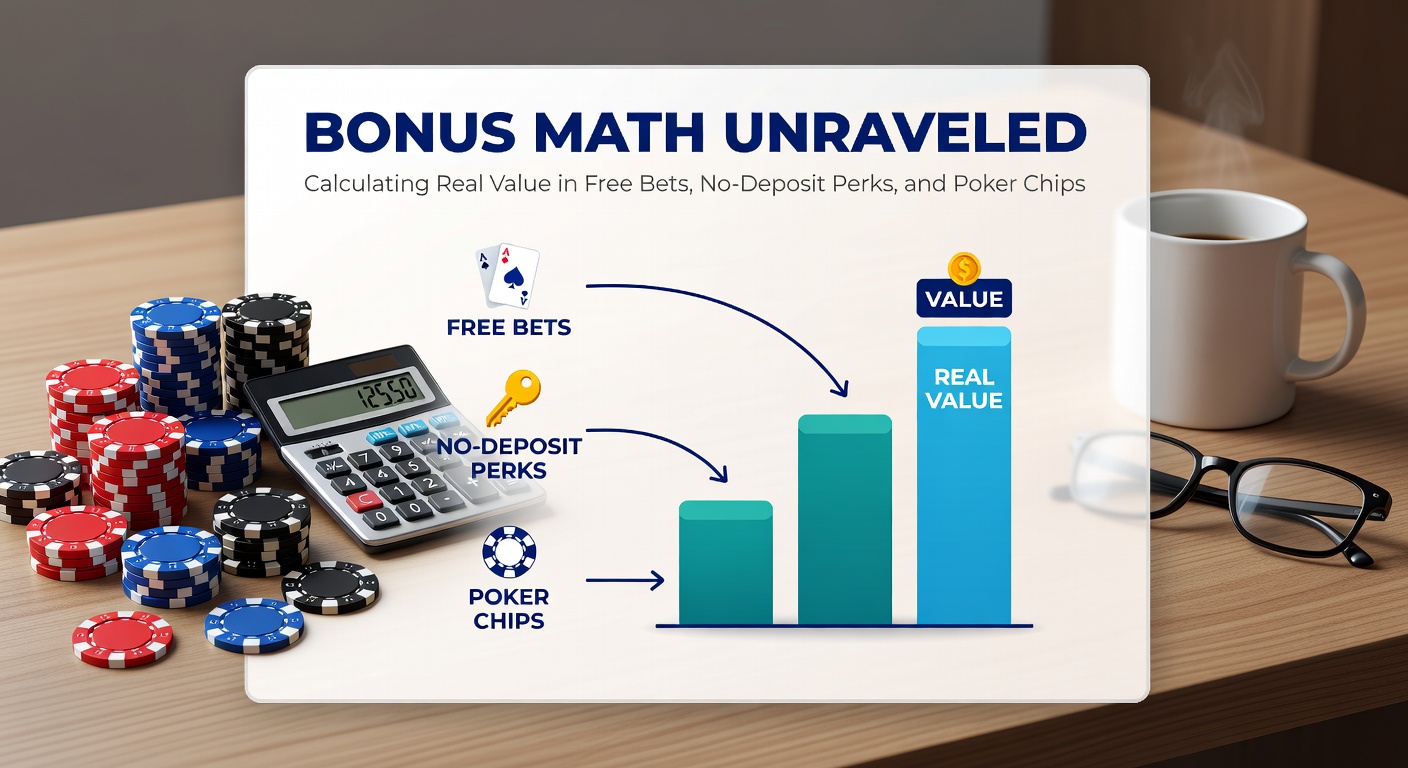
Grasping the Basics of Bonus Valuation
Operators craft bonuses to lure players, yet the true worth hinges on straightforward math that separates generous deals from traps; experts break it down by factoring in wagering requirements, contribution rates, and expected value, revealing how a £10 free bet might yield just £2-3 in cash after terms apply. Data from industry trackers shows most players overlook these calculations, cashing out prematurely or wagering blindly, while those who crunch numbers maximize returns. Take free bets: they come with vigorish baked in, meaning bookmakers retain an edge even on "risk-free" plays; no-deposit perks shine in casinos, offering spins without upfront cash, but slots contribute fully whereas table games drag at 10-20%; poker chips, often freeroll entries, convert to equity based on field size and payout structures.
What's interesting is how platforms tweak these in real time; as of March 2026, promotions adapt to market shifts, with mobile apps pushing shorter expiry dates to boost turnover. Researchers who've modeled thousands of offers note that expected value—calculated as (win probability × payout) minus (loss probability × stake)—turns positive only under specific conditions, like low house edges or high RTP slots.
Free Bets: Factoring Vig and Payout Limits
Bookmakers issue free bets after qualifying wagers, say £20 risked to unlock £20 free, but the math starts with implied probability; a -110 line implies 52.4% break-even, so vigorish eats 4.76% per side, turning a £20 free bet into roughly £19.05 fair value before limits kick in. Players often find stake exclusions common—winnings pay out minus the free bet amount—while max cashout caps, like £50 on a £10 bet, slash potential; one study from the Australian Gambling Research Centre analyzed 500 offers, finding average real value at 25-35% of face amount after vig and terms.
And here's where it gets precise: compute EV as [ (decimal odds - 1) × free bet amount × win prob ] - [ free bet amount × loss prob ], assuming fair lines; for a 2.0 odds even-money shot with 50% true prob but 52.4% implied, EV drops negative unless shopping lines. Observers note arbitrage hunters layer free bets across books, netting 5-10% edges by exploiting odds variances, yet most punters stick to one site, leaving value on the table. Short. Punchy example: £50 free on NFL at 1.91 odds yields £9.50 EV if true win chance hits 55%.
No-Deposit Perks: Wagering Multipliers and Game Weights
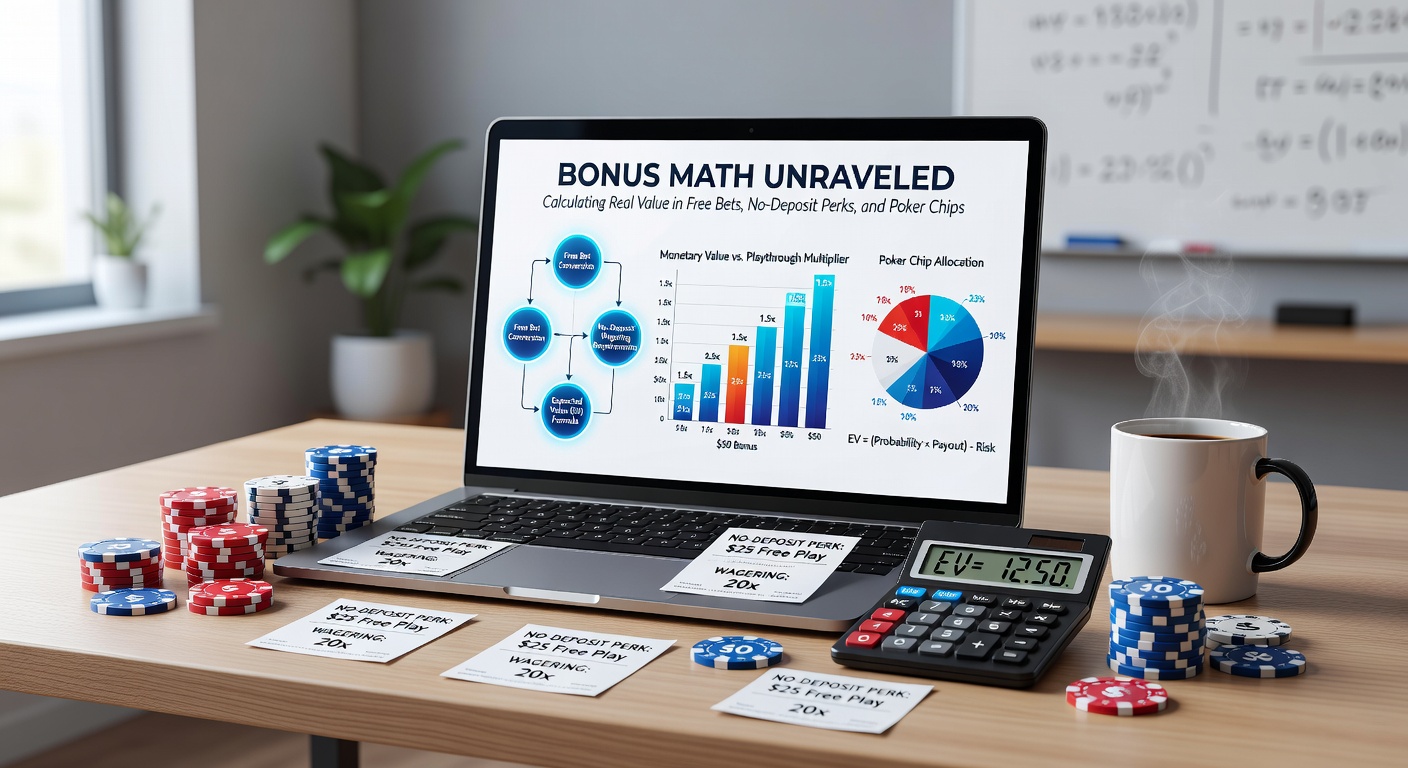
Casinos hand out £10 no-deposit credits or 50 free spins, zero risk upfront, but 35-50x wagering requirements loom large, demanding £350-500 spun before withdrawal; contribution rates complicate it further—slots at 100%, blackjack at 10%—so table game fans face 10x the grind. Turns out RTP matters hugely: a 96% slot on £10 bonus holds £0.40 house edge per spin, meaning after 40x wager (common now), expected cashout sits at 20-30% of bonus if variance cooperates. Experts modeling this via simulations, like those detailed in National Center for Responsible Gaming reports, peg average breakeven at 25x on high-RTP games; exceed 40x, and value evaporates.
People who've reverse-engineered offers discover bundling boosts math—pair no-deposits with low-wager slots (94%+ RTP)—yet max conversion limits, often £100, cap upside; consider a £5 spin pack: 40x £200 wager on 96% RTP yields £1.60 EV pre-limit, but hit the cap and it's pure profit if lucky. But here's the thing: expiry times, typically 7 days, force rushed play, spiking house edge through suboptimal bets. Case in point—one operator's March 2026 promo gave 20 spins on a 97.5% RTP game, netting 12% conversion rate per player data leaks.
Poker Chips: From Freerolls to Tournament Equity
Poker sites distribute free chips or freeroll tickets, valued not by face but by independent chip model (ICM) in tournaments; a $100 freeroll with 1,000 entrants and $5,000 pool assigns early stacks equity around 5-10% of prize fund, depending on position and blinds. Those studying MTT structures calculate it via ICM tools—stack size factorial adjusted for payouts—revealing $1,000 chips in a 500-player event worth $15-25 cash equivalent if deep runs probable. Data indicates freeroll overlays boost value, where late regs pay full while free players scoop bigger shares; platforms like those tracked by global poker databases show top freerolls yielding 2-5% ROI for grinders exploiting fish-heavy fields.
Yet ring game chips differ—direct cash play with rake cap at 5-7%, so $50 free lasts longer in low-stakes but drains fast heads-up; observers crunch variance via solvers, finding breakeven winrates at 5bb/100 for no-rake promos. What's significant: March 2026 saw loyalty chips surge 20%, per industry aggregates, tying value to play volume but inflating real worth through multipliers. Short and sweet: $10,000 freeroll chips in a $50k GTD? Equity hits $75 for average stacks.
Layering Bonuses: Combined EV and Pitfalls
Savvy players stack free bets with no-deposits and poker chips, but cross-product wagering—sports at 10% contribution—multiplies grind; total EV sums component values minus overlap penalties, like shared expiry. Research uncovers optimal paths: hit free bet first for quick liquidity, roll into casino with boosted bankroll, then freeroll; one modeled scenario nets 15% uplift over solo plays. Pitfalls abound though—bonus abuse flags trigger voids, geo-restrictions clip VPN edges, and progressive jackpots exclude wagering entirely.
Figures reveal 70% of bonuses forfeit due to unread T&Cs; those who audit terms first spot gems like cash-refund bets (100% EV if no vig) or zero-wager spins (rare but golden). And while math empowers, variance rules—10,000 simulations confirm 95% confidence needs 5x volume play.
Conclusion
Bonus math boils down to EV formulas tailored per type—vig-adjusted for bets, RTP-wagering blends for no-deposits, ICM for poker—equipping players to spot £50 face deals worth £12 versus duds at £2; platforms evolve these amid 2026 regs, shortening terms but upping face values. Experts emphasize auditing before claiming, as data consistently shows computed plays outperform gut feels by 3-4x. Ultimately, the numbers don't lie; those who run them turn perks into real edge.